International Travel Requirements
International travelers are responsible for meeting University requirements and the entry, transit, health, documentation, and legal requirements that apply to every destination and connection on the itinerary.
Plan international travel early
UCR encourages travelers to submit the Pre-Trip Request, book travel, and complete any required UC Away registration at least 21 days before international travel to allow time for approvals and additional travel requirements.
International travel involving UCR students should begin planning no less than six months in advance. High-risk destinations, research equipment, controlled information, sanctioned countries, visas, or complex group travel may require substantially more time.
Review UCR Travel Risk and Insurance Programs
Requirements before departure
| Requirement | Action and timing | Current authoritative sources |
|---|---|---|
| University and departmental approval | Obtain required approvals before making travel commitments. Submit and receive approval of the Concur Pre-Trip Request when required. Complete this before booking or incurring expenses. | UC Business and Finance Bulletin G-28, UCR travel policies, and departmental requirements |
| Federally funded airfare | Before ticketing, confirm that every flight segment complies with the Fly America Act. When an allowable exception applies, complete the Fly America Act Exception Form and retain supporting booking documentation. Review the Federally Funded Air Travel: Fly America Act guidance below. | GSA Fly America Act Guidance, applicable award terms, and UCR guidance |
| Travel registration and alerts | Register the complete itinerary, including every destination and transit point, before departure. A Concur Pre-Trip Request does not register the trip. Travel booked through Concur or ConnexUC is registered automatically, except for SWABIZ bookings. Register SWABIZ and other outside bookings manually in UC Away. | Registering UC Travel, UC Away, and Crisis24 |
| Passport, visa, entry, and transit requirements | Confirm passport validity and all visa, electronic travel authorization, entry, exit, and transit requirements before booking and again before departure. | Destination and transit-country authorities and U.S. Department of State Travel Advisories |
| Destination conditions and travel advisories | Review destination risks, UC travel direction, government advisories, health guidance, and local requirements before booking and again before departure. Determine whether a risk assessment, briefing, additional approval, or campus protocol applies. | UC Systemwide Travel Advisories, U.S. Department of State Travel Advisories, and UCR Risk Management |
| Export control and sanctions | Complete the International Travel – Export License Review at least one week before departure. Contact the Export Control Office earlier for travel involving equipment, software, technical data, research materials, fieldwork, restricted parties, sanctioned destinations, or international financial transactions. | UCR Export Control: International Travel |
| Health and medication | Confirm vaccination, medication, health, and medical-care needs before departure. Ensure medications comply with the requirements of every destination and transit country. | CDC Travelers’ Health, destination health authorities, and the traveler’s medical provider |
| Devices, data, and information security | Take only the University equipment and information required for the trip. Confirm applicable encryption, data-access, export-control, and device-security requirements before departure, and protect devices and information throughout the trip. | UCR Export Control and applicable UCR information-security requirements |
| Insurance, assistance, and emergency planning | Before departure, confirm insurance eligibility and exclusions. Save assistance contacts, the nearest U.S. embassy or consulate information, and the department’s communication plan. | UCOP Travel Risk and Insurance, UCR Travel Insurance and Assistance, UCR Emergency and Safety Resources, and UCR Risk Management |
| Copies of required travel documents | Carry accessible copies of required travel documents before and during travel. Protect passport, identity, health, and other sensitive information from unauthorized access. | Destination and transit-country authorities, the traveler’s insurance provider, and applicable UCR information-security guidance |
Federally Funded Air Travel: Fly America Act and Open Skies Guidance
Air travel charged to a federal grant or contract, including a federal flow-through award, must comply with the Fly America Act and any applicable Open Skies Agreement. Compliance is the responsibility of the department and Principal Investigator. Before purchasing airfare, confirm that every flight segment uses an eligible U.S.-flag carrier or qualifying codeshare, or that the itinerary meets the requirements for an allowable exception. Travel that does not comply with the Fly America Act cannot be charged to the federal award and may require a non-federal funding source.
-
Before Booking Airfare
Before purchasing airfare for travel charged to a federal or federal flow-through award:
- Confirm the funding source. Determine whether the trip will be charged, in whole or in part, to a federal or federal flow-through award.
- Review every flight segment. Review connections and return flights, not only the longest segment. Confirm the ticketed airline designator and flight number for each segment.
- Review the award terms. Sponsor-specific or award-specific requirements may be more restrictive than the general Fly America Act requirements.
- Resolve exceptions before purchasing. If a foreign carrier may be necessary, determine whether an allowable exception applies and retain the supporting flight searches available at the time of booking.
Travelers must use a U.S.-flag carrier or qualifying U.S.-carrier codeshare unless the itinerary meets the requirements for an allowable exception.
-
Codeshares and Multi-Segment Itineraries
Codeshares and Multi-Segment Itineraries
For a codeshare flight, the airline designator and flight number shown on the ticket determine Fly America Act compliance.
A flight may qualify when a foreign airline operates the aircraft, provided the ticket displays a U.S. carrier’s designator and flight number. A U.S. codeshare available on the same aircraft does not make the traveler’s ticket compliant if the purchased ticket displays the foreign carrier’s designator.
For itineraries containing multiple flights, review every ticketed segment separately. One compliant segment does not make the entire itinerary compliant.
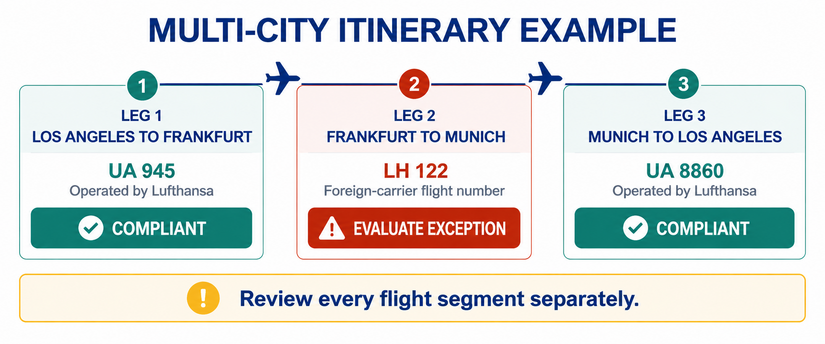
Example: Each segment must be evaluated using the airline designator and flight number shown on the traveler’s ticket.
Segment Ticketed flight Operating carrier Result Los Angeles to Frankfurt UA 945 Lufthansa Compliant U.S.-carrier codeshare Frankfurt to Munich LH 122 Lufthansa Foreign-carrier flight number; review for an allowable exception Munich to Los Angeles UA 8860 Lufthansa Compliant U.S.-carrier codeshare -
Allowable Exceptions
When an Exception May Apply
Federal guidance recognizes limited circumstances in which a foreign carrier may be used, including:
- No U.S.-flag carrier service is available.
- Using a U.S.-flag carrier would extend the total travel time by 24 hours or more.
- A U.S.-flag carrier does not provide nonstop or direct service, and using available U.S.-carrier service would:
- Increase aircraft changes outside the United States by two or more;
- Extend travel time by six hours or more; or
- Require a connection of four hours or more at an overseas interchange point.
- The scheduled flight time is less than three hours and using a U.S.-flag carrier would at least double the travel time.
- An applicable Open Skies Agreement permits the use of the foreign carrier.
A lower ticket price, traveler preference, or convenience alone does not qualify as an exception. Award-specific requirements may also be more restrictive than the general federal rules.
When an exception applies, complete and sign the Fly America Act Exception Form. Attach the form and all supporting documentation to the Concur Expense Report.
Completing the form does not, by itself, make a noncompliant itinerary allowable. The selected exception must be supported by the itinerary and booking-time documentation.
-
Open Skies Agreements
An Open Skies Agreement may permit the use of an eligible foreign carrier for certain federally funded international travel. An agreement does not automatically make every foreign-carrier flight allowable.
Before relying on an Open Skies Agreement:
- Confirm that the route and foreign carrier qualify under an applicable agreement.
- Determine whether a GSA City Pair fare applies to the origin and destination.
- Confirm that the travel is not funded by the Department of Defense or a military department.
- Review the award terms for additional sponsor restrictions.
- Retain the City Pair search and other flight-search results available at the time of booking.
Complete the Fly America Act Exception Form and identify the applicable Open Skies exception.
Review the GSA Fly America Act and Open Skies guidance and the GSA City Pair Search before purchasing the ticket.
-
Required Documentation and Review
Retain documentation that identifies the complete itinerary and supports compliance for every flight segment.
For federally funded foreign travel, include the following with the Concur Expense Report, as applicable:
- A detailed itinerary showing every flight segment, flight number, and ticketed and operating carrier;
- The booking confirmation and airfare receipt;
- Boarding passes or other carrier documentation when the booking record does not contain sufficient detail;
- Booking-time flight-search results supporting the selected exception;
- GSA City Pair search results when relying on an Open Skies Agreement;
- The completed and traveler-signed Fly America Act Exception Form, when applicable;
- Lodging receipts;
- Meal receipts when claimed expenses exceed the approved per diem rates; and
- Receipts for other reimbursable costs, such as visa fees, ground transportation, and parking.
A general Expedia or Anthony Travel confirmation is not sufficient when it does not identify every segment, flight number, and applicable carrier. Provide a detailed itinerary from the carrier, travel agent, or online booking service, or boarding passes covering the entire trip.
Extramural Funds reviews federally funded foreign travel documentation before Accounts Payable completes the reimbursement. The department may be contacted if additional information is needed.
Review the Foreign Travel Documentation Requirements for Federally Funded Awards.
-
Common Questions and Resources
Common Questions
What if the foreign-carrier flight is less expensive?
A lower price, by itself, does not qualify as an exception.What if a foreign airline operates the aircraft?
Check the ticketed airline designator and flight number. A U.S.-carrier flight number may qualify even when a foreign airline operates the aircraft.What if the airfare has already been purchased?
Determine whether an allowable exception applies. Completing an exception form after purchasing the ticket does not correct noncompliance when no valid exception exists.What if the airline changes the flight involuntarily?
Retain the original compliant itinerary, cancellation or change notice, and revised booking. Document the circumstances and determine whether an exception applies.What happens if the airfare does not comply?
The airfare cannot be charged to the federal award. The department must identify an appropriate non-federal funding source.
Resources
Additional international travel considerations
-
Faculty-led or student group travel
Faculty traveling with UCR students must complete their own registration requirements and ensure the group is registered in UC Away before departure.
Begin planning at least six months in advance to address program review, supervision, insurance, destination risk, emergency communications, and other activity-specific requirements.
-
Research, equipment, samples, or fieldwork
Contact the UCR Export Control Office early. Hand-carrying, shipping, sharing, or accessing equipment, software, technology, technical data, research materials, or services abroad may require additional review, documentation, a license, an exception, or a control plan.
-
Sanctioned or high-risk destinations
Do not rely only on a destination’s U.S. Department of State advisory level. U.S. sanctions, UC advisories, insurance restrictions, and campus protocols may also apply.
Contact UCR Risk Management and the Export Control Office before making financial or travel commitments.
-
Laptops, mobile devices, and sensitive information
Take only the information and equipment required for the trip. Follow UCR information-security and export-control requirements, maintain control of devices, use approved connections, and report loss, theft, or suspected compromise promptly.
-
Personal travel connected to University business
Identify personal dates, destinations, companions, and side trips before booking. Retain a business-only cost comparison and exclude personal expenses from University payment or reimbursement requests.
Travel registration and UC insurance eligibility may not apply to personal portions of the trip or to companions.