Travel Reimbursements
Use Concur to report reimbursable travel expenses, reconcile University-paid expenses, return unused travel advances, and document the final cost of an authorized University business trip. Expenses must be reasonable, necessary, documented, and directly related to a clear University business purpose.
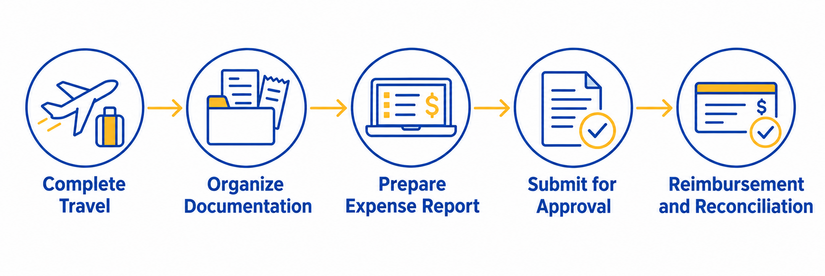
The reimbursement process
| Step | What happens |
|---|---|
| 1. Complete the trip | Retain itemized receipts, itineraries, agendas, approvals, and other supporting documentation while traveling. |
| 2. Organize the expenses | Separate University business expenses from personal expenses and identify how each charge was paid. |
| 3. Prepare the Expense Report | Add reimbursable out-of-pocket expenses, T&E Card transactions, direct-billed expenses, advances, refunds, and credits to the appropriate Concur Expense Report. |
| 4. Attach documentation | Provide the business purpose and attach the receipts, comparisons, approvals, and other documentation required for each expense. |
| 5. Submit and approve | Submit the report within the applicable deadline. The department reviews the report for accuracy, funding, documentation, and policy compliance. |
What belongs on the Expense Report?
| Expense type | Reporting requirement |
|---|---|
| Out-of-pocket expense | Add the allowable expense and identify the traveler as the payee. |
| T&E Card transaction | Add and reconcile the imported card transaction, even though the University has already paid the card balance. |
| University direct-billed expense | Include the expense so the complete cost of the trip is documented, even when no reimbursement is due to the traveler. |
| Travel advance | Apply the advance to the report and return any amount not supported by allowable expenses. |
| Refund or credit | Document the refund or credit and apply it to the appropriate trip or University-paid transaction. |
| Personal expense | Do not request reimbursement. If a personal charge appears on a University card, immediately identify and reconcile the transaction and repay the University, payable to UC Regents, as directed. Unrepaid amounts may be deducted from the cardholder’s paycheck and may result in corrective action and/or loss of card eligibility. |
Submission deadlines
Expense Reports submitted after the applicable deadline may be denied, charged to another funding source, or treated as taxable income, depending on the circumstances. Departments or funding sources may establish an earlier deadline.
| Report or transaction | Deadline |
|---|---|
| General travel Expense Report | Submit within 45 days after the trip ends. |
| Report containing T&E Card transactions | Reconcile and submit within 30 days after the related trip or event ends. |
| Trip lasting more than 90 days | Submit Expense Reports at least quarterly. |
| Travel advance | Account for the advance on an Expense Report within 45 days after the trip ends and promptly return unused funds. |
Responsibilities
A Concur Delegate may assist with preparing a report, but the traveler remains responsible for the accuracy and business purpose of the expenses submitted on the traveler’s behalf.
| Role | Responsibility |
|---|---|
| Traveler | Provide a complete business purpose, retain documentation, identify personal expenses, confirm the accuracy of the report, and complete required certifications. |
| Concur Delegate | Prepare the report when authorized, attach documentation, and communicate with the traveler about missing or unclear information. |
| Financial Approver or Financial Previewer | Confirm that expenses are allowable, reasonable, properly documented, correctly funded, and approved at the required level. |
| Traveler and department | Respond promptly when a report is returned for correction or additional documentation. |
Travelers, students, and guests
UC Riverside employees, students, and guests may be reimbursed for reasonable and necessary University business travel expenses under UC travel policy.
Students or guests who do not prepare their own reports must work with a departmental Concur Delegate. Required guest setup and Guest Traveler Routing must be completed before the delegate begins entering the guest’s request or expenses in Concur.
Business and personal travel
When University business travel includes personal dates, destinations, companions, or routing:
- Identify the personal portion of the trip.
- Attach the business-only cost comparison obtained at the time of booking.
- Exclude expenses associated with personal days or activities.
- Request no more than the allowable business-only cost.
- Repay any personal amount charged to a University payment method.